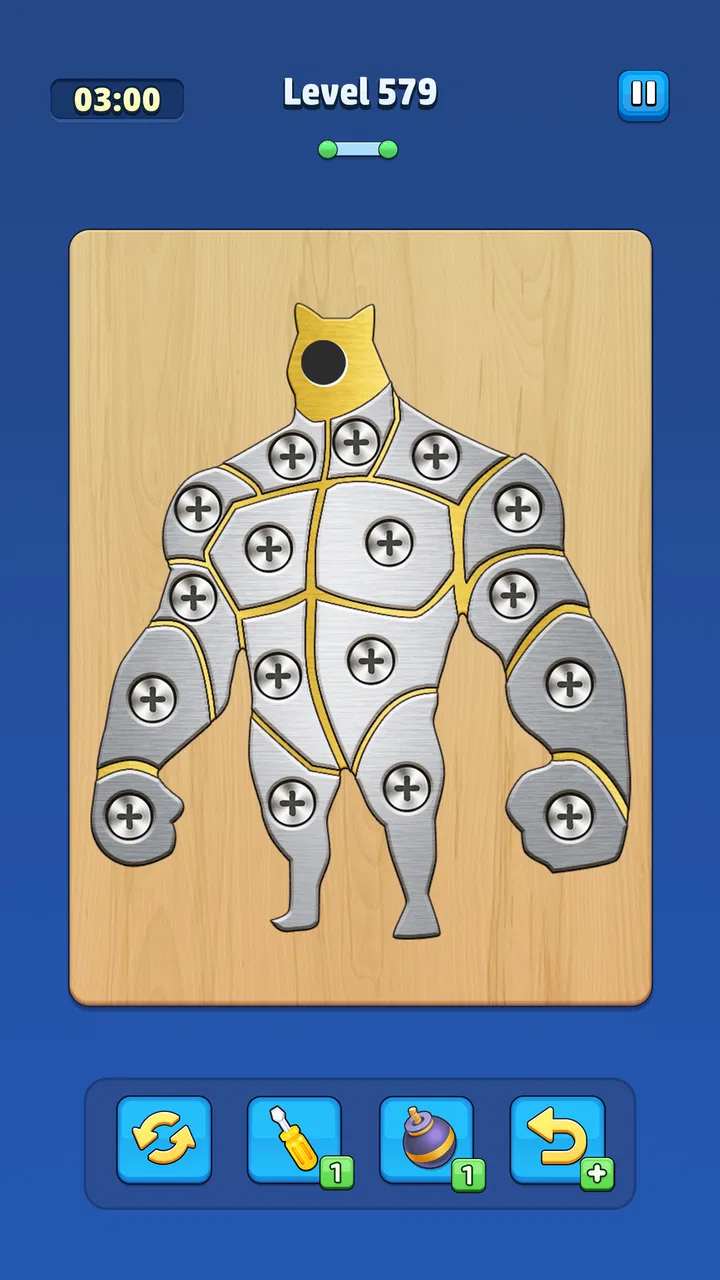
Take Off Bolts: Screw Puzzle
- 4.1
- Rating
- 10.00M
- Installs
- Free
- Price

 Analysis by App-foxy
I went into Take Off Bolts: Screw Puzzle expecting a quick casual diversion, and that is exactly where it works best. This is a free puzzle game from Playful Bytes in which the main challenge is to remove bolts in the right order and clear the pieces from the board. The idea is easy to understand, but the decisions become more demanding when one move changes which bolts remain reachable.
What makes it worth trying is the physical logic of the boards. I am not simply matching colors or sliding tiles into place. I have to read the arrangement, notice which fasteners are blocking others, and plan several moves ahead. That gives each level a satisfying “look again” quality. It is a good fit for short breaks, especially when I want something quiet and focused rather than a game that demands constant speed.
The game is listed as a free puzzle title for Everyone, and it has reached over 10 million installs with a 4.4 average from around 42 thousand ratings. Those figures suggest that the basic format has found a broad audience, but popularity does not make every puzzle equally enjoyable. My experience is that the strongest appeal comes from the simple tactile problem-solving, while the weaker side appears when a level feels more like trial and error than deduction.
You May Also Like

 Blood Strike: 2.5 Anniversary
Blood Strike’s Loadouts Turn Every Drop Into a Tactical Gamble
A close look at Blood Strike’s custom loadouts: how fast access to signature weapons reshapes its battle royale rhythm, rewards preparation, and narrows the gap between fights.

 Pandora - Music & Podcasts
Pandora’s Music Is Easy to Start, but Harder to Recover
Pandora’s strength is its low-effort path from a seed to a station. Its weak spot is how much confidence it asks you to place in connection, setup, and quiet recovery.

 8 Ball Pool
 Is Built on Rivalries, Rematches, and Routine
A close look at the rivalries, rematches, shared routines, and unanswered safety questions that turn a quick pool match into a persistent mobile community.

 Samsung Music
’s Quiet Strength Is Playing What You Already Own
Its reach comes less from spectacle than from dependable access to a personal library. That simplicity is both the app’s strongest retention engine and its ceiling.

 AccuWeather: Weather Radar
AccuWeather Review: A Quick, Clear Forecast for Everyday Decisions
For everyday plans, the best forecast is the one you can understand quickly. AccuWeather makes rain timing, radar, and local conditions easy to act on, with a few trade-offs.

 Hill Climb Racing
Why Hill Climb Racing Still Turns Crashes Into One More Run
A tiny car, a bumpy hill and one more upgrade: Hill Climb Racing keeps resurfacing because its simple chaos makes every near-miss feel personal.
More From Our News Desk



How the bolt puzzles feel in everyday play
I find the everyday appeal of these bolt puzzles lies in how a quick glance can turn into a small planning exercise. In this section, I focus on the moment a layout stops looking obvious and the order of moves starts to matter, including a practical way to approach that pause. That leads into what I think returning players should keep in mind about the game’s current version.
A simple rule with more depth than it first appears
The opening concept is immediately readable: take off the bolts, free the obstructed parts, and keep the board moving toward an empty state. I like that the game does not need a long explanation before I can start thinking. The visual arrangement itself tells me what matters, so I can begin playing without learning a complicated control system.
The important skill is not tapping quickly. It is identifying dependency. A bolt may look removable, but taking it away too early can leave another piece in an awkward position or remove the space needed for a later move. I learned to pause before committing, especially on denser layouts. That small habit is more useful than rushing through the first available action.
For a realistic everyday scenario, this works well during a short wait at a bus stop or while a kettle is boiling. I can play one puzzle, put the phone down, and return later without needing to remember a large story or a complicated set of objectives. The mental reset is similar to a crossword or a compact logic puzzle, but the board gives the task a more hands-on feel.
Why the visual arrangement matters
The best moments come when I stop viewing the board as a pile of separate objects and start viewing it as a sequence of unlocks. One removed bolt can expose an opening, which then makes another move possible. That chain is the central pleasure of the game. I get a clear sense that the solution came from understanding the layout rather than from tapping randomly.
My practical tip is to scan for bolts that are doing more than one job. If a fastener appears to hold several parts in place, it deserves attention, but it may also be dangerous to remove first. I usually check the surrounding spaces and ask which move creates the most room. This approach reduces unnecessary restarts and makes difficult boards feel more manageable.
Another useful habit is to separate a “safe” move from a “necessary” move. A safe move is one that opens space without disrupting the rest of the arrangement. A necessary move may look risky but is the only way to reach a blocked area. Recognizing that difference gives the puzzles more structure and prevents me from treating every available bolt as equally important.
Who will enjoy it most
I would recommend it to players who enjoy compact logic challenges, visual organization, and gradual problem solving. It suits people who prefer a calm pace and like discovering the correct order through observation. It can also work for someone who normally avoids puzzle games because the central rule is much easier to grasp than the rules of a traditional strategy title.
It is less suitable for anyone looking for a narrative adventure, competitive multiplayer, or a puzzle game built around words and general knowledge. There is no reason to choose this over a crossword if language is the part you enjoy most. Likewise, players who want rapid reflexes or elaborate character progression may find the bolt-clearing format too narrow.
How it compares with familiar puzzle alternatives
Compared with match-three games, this asks for more planning and less reaction. I am not waiting for a lucky combination or chasing a chain reaction. Compared with sliding-block puzzles, the emphasis is less about moving one item through a fixed maze and more about controlling the order in which the board becomes accessible.
It also differs from sudoku and word puzzles because the information is spatial rather than numerical or linguistic. That makes it a good alternative when I want to exercise attention without doing calculations or searching for vocabulary. The trade-off is that the game’s variety depends heavily on how interesting the board layouts are. A strong arrangement feels clever; a repetitive one can feel like routine clearing.
Current state, changes, and the experience for returning players
When I come back to a puzzle game after time away, I want to know whether I can pick it up without relearning its basic logic, and whether its latest version changes the experience in a meaningful way. Here, I look at how the familiar bolt-removal idea shapes that return and what I would pay attention to before settling into another round.
What the current release tells me
The current version is 1.19.0, and the game was released on January 25, 2024. I see that version number as a sign of an actively maintained product rather than a one-off experiment. It also means returning users should judge the present build rather than rely entirely on impressions from the launch period.
At the same time, a version number alone does not tell me that every part of the experience has been transformed. I would not treat the latest release as proof of a completely redesigned puzzle system. The safest conclusion is that Playful Bytes has continued developing the game, while the fundamental appeal remains the bolt-and-board logic that defines it.
For a new player, that continuity is helpful. I can install it and understand the point quickly. For an existing player, the main question is whether the newer build keeps the puzzles feeling fresh enough over time. That depends less on the label of the update and more on the variety, balance, and pacing of the boards encountered during play.
What changes mean for existing users
If I had already played an earlier build, I would approach the update with moderate expectations. A current version can improve the overall polish or adjust the flow without changing the identity of the game. That is usually a good thing for a puzzle title: familiar rules make it easier to continue, while refinements can make the session feel smoother.
The benefit for returning users is that they do not need to relearn an entirely different game. The cost is that anyone who has exhausted the most satisfying patterns may still want a stronger sense of novelty. In this kind of title, long-term interest comes from new arrangements and fair difficulty, not merely from keeping the same interaction available.
I also think the game is best treated as a flexible collection of short challenges rather than a hobby that must occupy every evening. That expectation makes the experience more rewarding. I can return when I want a focused break, solve a few boards, and stop before the repetition becomes noticeable.
Free access and the purchase decision
The game is free to download, with in-app purchases ranging from $1.49 to $49.99 per item. That makes the initial decision easy: I can try the core experience without paying first. The more important question is how comfortable I am with the game’s commercial layer during longer sessions.
I would not spend money immediately. I would first play enough to decide whether the board design itself holds my attention. If I enjoy the central logic but dislike interruptions or feel pushed toward purchases, that changes the value calculation. A free puzzle game is only a good fit if its pacing remains comfortable for the way I intend to use it.
My advice is to consider purchases as optional support for a game I already know I enjoy, not as a shortcut to understanding it. Spending more does not make the reasoning better. The satisfaction comes from finding the order myself, so I would be cautious about turning difficult boards into a sequence of paid solutions or boosts if that weakens the challenge I came for.
Limitations that become clearer over time
The biggest limitation is the narrowness of the central idea. Removing bolts is satisfying, but it cannot provide the same range as a puzzle game with several distinct modes. If I play for a long stretch, I may start noticing the underlying rhythm: inspect, choose an opening, clear a path, and repeat.
Difficulty can also feel personal. A board that looks obvious to one player may be surprisingly awkward to another because visual clutter affects how quickly the dependencies can be read. I prefer puzzles that reward a clear plan, but a layout that hides the key relationship too well can feel less like logic and more like guessing.
There is also a difference between a game that is excellent for five minutes and one that remains compelling for an hour. This title is strongest in the first category. I would not install it expecting a deep campaign with a dramatic conclusion. I would install it as a dependable pocket puzzle, then decide naturally how long each session should last.
Device fit and practical expectations
The minimum operating-system requirement is Android 8.0, so owners of compatible Android devices should have a reasonable starting point for installation. The Everyone age rating also makes the concept approachable for a wide range of players. The board-based format is easy to explain, which makes it suitable for sharing with a family member who enjoys visual puzzles.
Even so, age suitability does not mean every puzzle will be equally accessible. Younger players may understand the tapping quickly but still need patience for planning several moves. I would introduce it as a thinking game rather than a reaction game, and I would encourage experimenting with the layout instead of treating an unsuccessful attempt as a failure.
What I would watch in future updates
For future development, I would pay closest attention to how Playful Bytes handles variety and fairness. More boards are useful only when they introduce genuinely different relationships between bolts and pieces. I would rather see a smaller set of memorable layouts than a long run of arrangements that feel interchangeable.
I would also watch the balance between challenge and frustration. The ideal puzzle gives me enough information to reason toward a solution, even when the answer is not immediately visible. If a future version makes mistakes feel more understandable, that would improve the experience more than simply increasing complexity.
Another point worth watching is how the free structure affects the rhythm of play. The game’s appeal depends on short, uninterrupted thinking sessions. Anything that breaks that concentration too often would matter more here than in a fast arcade game. Conversely, a thoughtful update that preserves the calm pace could make the title more useful for regular short breaks.
My recommendation after spending time with it
I recommend this game to anyone who wants a straightforward spatial puzzle with enough planning to make each successful board feel earned. Its strongest quality is the way a small rule creates meaningful order-of-moves decisions. I especially enjoy it when I have a few spare minutes and want to focus on one contained problem instead of committing to a long session.
I would skip it if I need rich variety, a story, online competition, or a puzzle system that keeps changing its rules. I would also be cautious if I know I dislike games where a single early choice can require a restart. That friction is part of the design, but it will not suit every player.
Overall, the current release presents a polished-feeling concept with a clear audience: people who enjoy visual logic, gradual unlocking, and bite-sized challenges. The free entry point makes trying it low risk, while the purchase range means I would evaluate the monetization at my own pace. The best way to enjoy Take Off Bolts: Screw Puzzle is to treat each board as a small planning exercise, not as a race to remove everything as quickly as possible.
FAQs for Take Off Bolts: Screw Puzzle
01What is the main objective of Take Off Bolts: Screw Puzzle?
The main objective of Take Off Bolts: Screw Puzzle is to challenge players with a series of mechanical puzzles where they must unscrew bolts in the correct order to progress. Each level presents a unique set of bolts and screws, requiring strategic thinking and planning to solve them efficiently.
02Is Take Off Bolts: Screw Puzzle suitable for all age groups?
Yes, Take Off Bolts: Screw Puzzle is designed to be enjoyed by players of all ages. The game offers a range of difficulty levels, making it accessible for younger players while still challenging enough for adults seeking a brain-teasing experience. However, parental guidance is recommended for very young children.
03Does Take Off Bolts: Screw Puzzle require an internet connection to play?
Take Off Bolts: Screw Puzzle can be played offline, making it a great option for gaming on the go without needing a constant internet connection. However, some features, such as leaderboards or in-app purchases, may require online access to function properly.
04Are there in-app purchases in Take Off Bolts: Screw Puzzle?
Yes, Take Off Bolts: Screw Puzzle includes in-app purchases. Players can buy hints, extra levels, or cosmetic upgrades to enhance their gameplay experience. While the base game is free, these purchases can offer additional content or assistance for those who wish to progress more quickly.
05How does the difficulty level progress in Take Off Bolts: Screw Puzzle?
The difficulty in Take Off Bolts: Screw Puzzle scales as players advance through the levels. Early puzzles are relatively simple, designed to familiarize players with the mechanics. As players progress, the puzzles become more complex, introducing new challenges and requiring more advanced problem-solving skills to complete.
Pros
- Engaging puzzle mechanics with increasing difficulty.
- Visually appealing graphics and smooth animations.
- Intuitive controls make gameplay accessible to all.
- Offers offline play to enjoy without internet.
- Regular updates with new levels and challenges.
Cons
- Occasional ads can interrupt gameplay flow.
- Limited hints may frustrate some players.
- In-app purchases required for extra features.
- Battery consumption can be high on longer sessions.
- No multiplayer mode for shared challenges.

Take Off Bolts: Screw Puzzle
Gallery